Back to Blog
Community7 min read
How to Apply to the AWS Community Builders Program in 2027
October 10, 2026
October 10, 2026
You cannot build a credible contribution history in the week before an application closes.
The AWS Community Builders application for the 2027 cycle opens in January 2027. As of October 2026, that gives you roughly three months to decide what you want to share, make useful contributions, and keep a clear record of them. AWS has said that applications are assessed through a track record of public technical content that helps other builders.
I learned this by applying twice. My first attempt started too late. I did not have enough public work to show. The next year, I applied with a stronger record of sharing what I had learned, speaking at a community meetup, and taking part in data and AI podcasts. I was accepted in the AI Engineering category.
Here is what I wish I had known before my first application.
AWS Community Builders is a global program for people who build with AWS and share knowledge with the technical community. The original AWS program announcement describes technical resources, mentorship, networking, and access to AWS product teams as part of its purpose. The current AWS Community Builders page links to a waitlist for the next application period.
You do not need to wait until you feel like an expert to start contributing. A practical tutorial, a clear explanation of a problem you solved, an open-source example, or a talk that helps other people learn can all make your experience useful to someone else. The point is to show what you have learned and how you share it.
AWS Heroes is a separate program. AWS describes Heroes as AWS experts whose knowledge-sharing has made a real impact in the community. The AWS Heroes page showcases those community leaders.
I think of the two programs as different forms of recognition, not successive ranks. Community Builders gives contributors a place to learn, connect, and grow their public work. Heroes recognizes experts with an established record of significant community impact. You do not need to be an AWS Hero before applying to become a Community Builder.
The benefits I value most are the people and the opportunities to learn. I have met fantastic builders from across the world, exchanged ideas with people working on different problems, and had access to information about AWS features before they were public.
Being part of the community helped create opportunities for me to speak more often: I spoke at AWS Summit Warsaw, where I had my largest audience so far, and at community meetups in two cities. In October 2026, I am leading workshops on building agents on AWS.
Benefits have included:
These can change between application cycles, so check the official program page for current details before applying.
For me, the program has been valuable because it has helped me learn and contribute in a community. The benefits are useful; sharing knowledge is what makes participation meaningful.
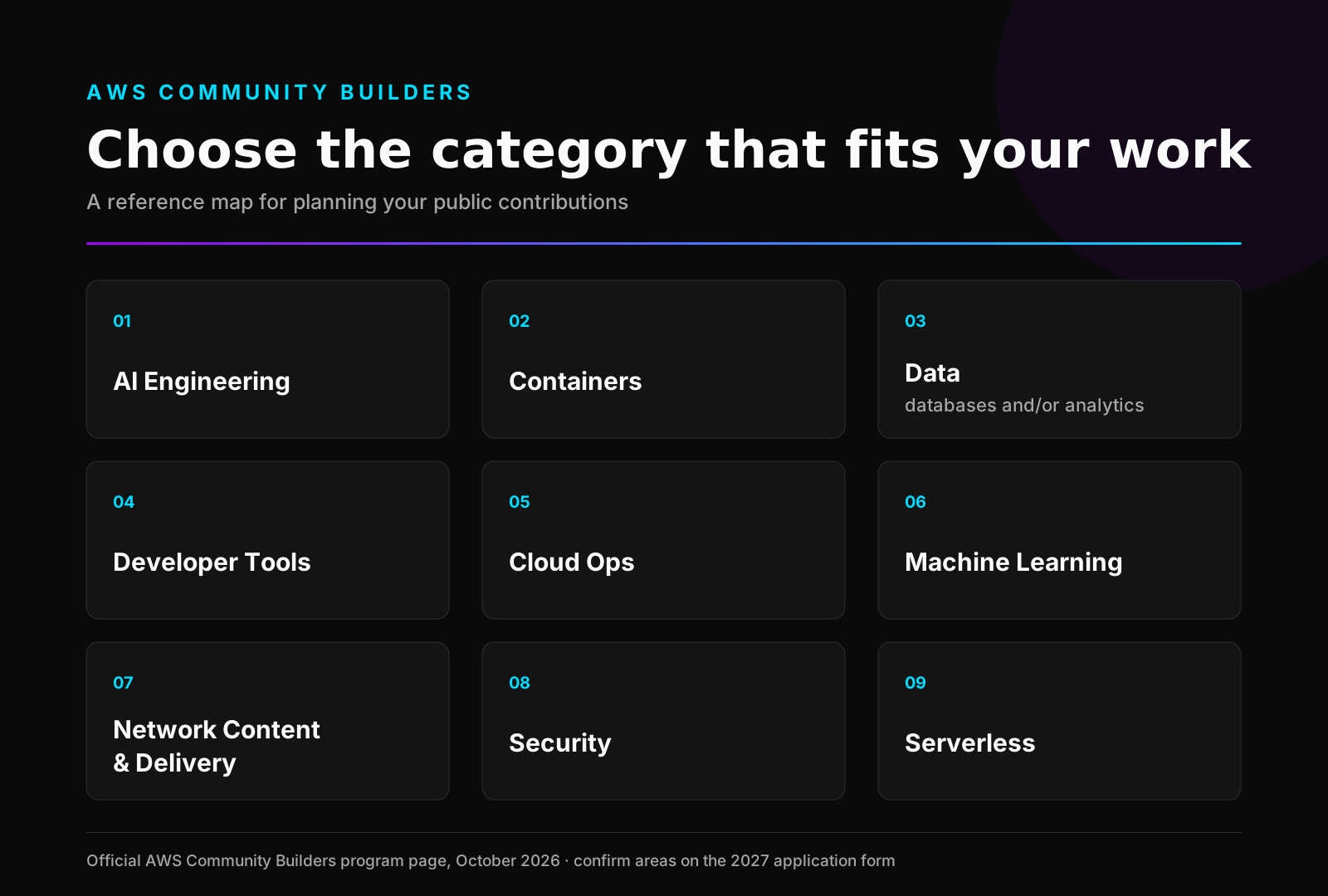
The official program page currently lists nine technology areas:
The 2027 application form is not open yet, so confirm the options on the live form before applying. Choose the area that best matches the work you have actually shared, rather than the one that sounds most impressive. My category is AI Engineering.
A strong application highlights public technical contributions that help other builders and conveys your passion for the technology. That could include articles, tutorials, videos, open-source work, or technical talks at community events. Your application should make it easy for someone to understand what you know, what you have shared, and who it helped.
As you prepare, focus on four things:
These are preparation practices, not a substitute for the official form. Follow the instructions and criteria shown when the application opens.
Three months is enough time to prepare thoughtfully. It is not enough time to invent a history of community contribution. Start from what you are learning or building now, and make the useful parts visible to others.
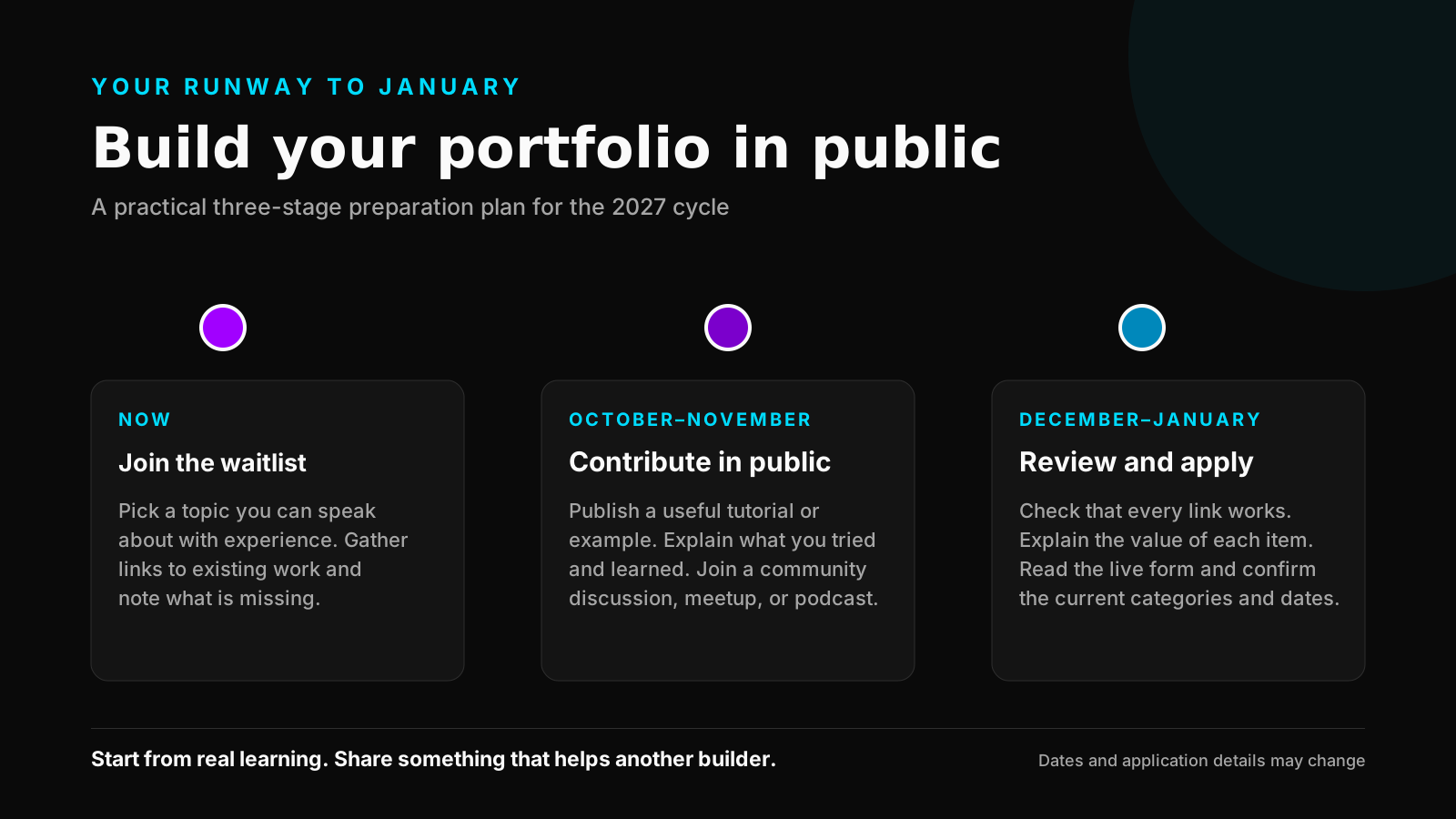
Now: Join the waitlist via the official AWS Community Builders page. Then pick the topic you want to contribute to. Gather links to work you have already shared, and note what is missing. Ask yourself what would genuinely help someone who is one step behind you.
October and November: Share one or two useful pieces of work, such as a tutorial, a small working example, or a talk. Explain the decisions and trade-offs, not only the final result. Take part in a meetup, podcast, or community discussion if that suits the way you like to contribute.
December: Review your public links. Make sure they work without special access, describe each contribution in a sentence, and explain what a reader can learn from it. Prepare honest answers about your journey and why you want to contribute.
January: When applications open, return to the official Community Builders page. Confirm the deadline, categories, benefits, and questions in the current form before you submit.
The AWS community had a real influence on how I learned. I joined to learn from more experienced colleagues, understand best practices, and meet people with similar interests. At first, I was mostly asking questions. As my experience grew, I could ask better ones, get more specific advice, and eventually give back by sharing my own knowledge and experience.
At the same time, I was managing a large team of AWS experts. I wanted to deepen my own knowledge so I could better support the team and our clients. I was also responsible for AWS partnerships in two companies, which gave me a closer view of the ecosystem and the support AWS provides to its partners and developers.
On my first application, I started preparing too late. I lacked the public contributions I needed and did not meet the requirements. I was disappointed, but I did not give up. By the next year I had more examples of sharing my experience, had spoken at a community meetup, and had participated in podcasts about data and AI. That time, I was accepted as an AWS Community Builder in AI Engineering.
So far, the experience has brought me new people to learn from, a certification voucher, early information about AWS features, and chances to speak to larger audiences. The first attempt was useful too: it showed me that the best preparation is to start contributing before you need an application link.
If you are considering applying, do not wait for January to begin. Pick a subject you care about, make your learning useful to someone else, and keep track of your public work. The application is one moment. The community grows from what you share before and after it.
For the latest information and the 2027 waitlist, visit the official AWS Community Builders page.
If you are preparing an application and want to compare notes or ask for advice, send me a DM on LinkedIn. I am happy to share what I learned from applying twice.